

What is ISMIC? Who is behind it? Why does it matter?
Jaunary 7, 2015. A special day, but for all the wrong reasons…
A special day, but for allthe wrong reasons…
Sharing what we know to help others…
Who are we, and why should you listen?
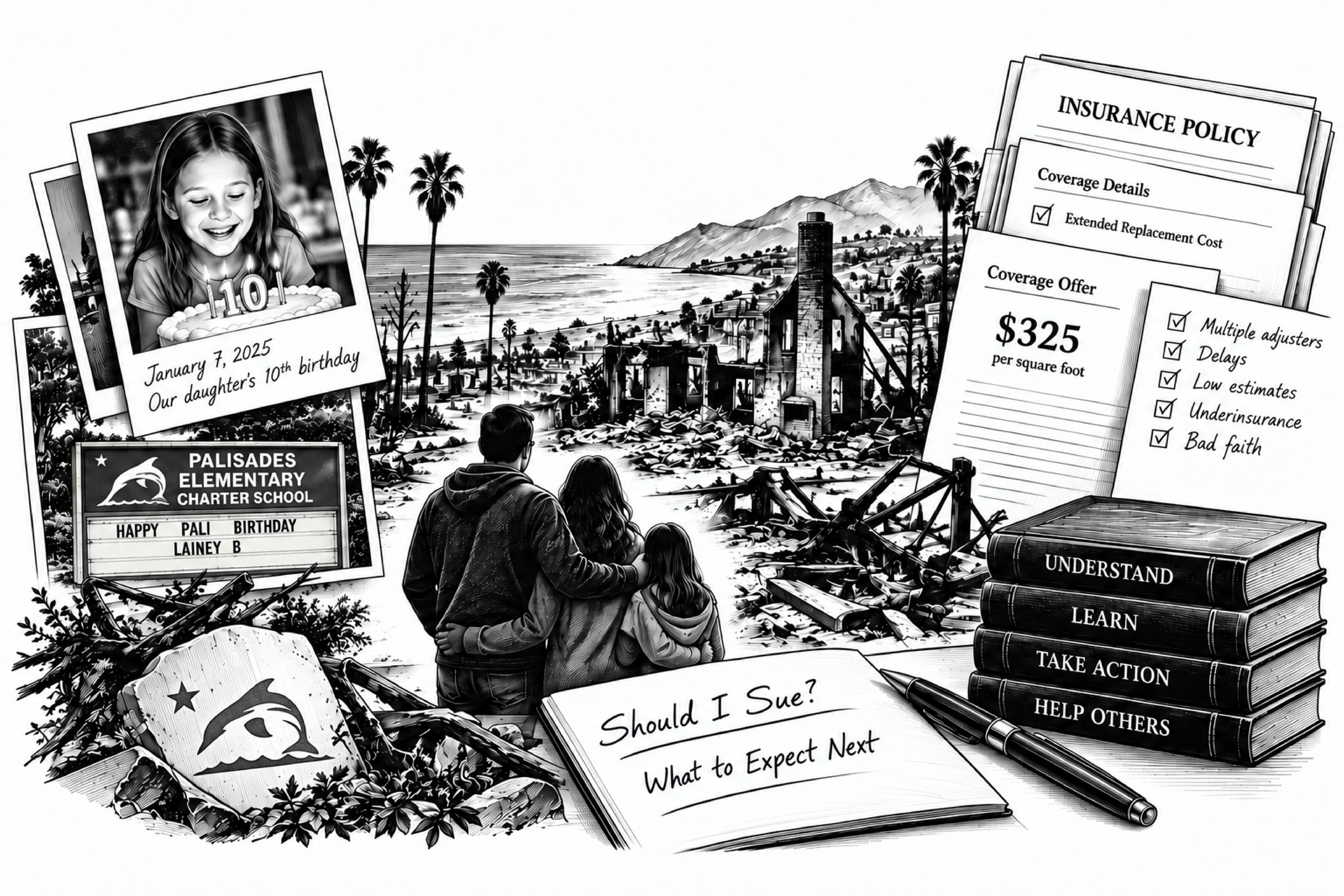
For our family, January 7, 2025, was supposed to be a special day. It was our daughter s 10th birthday. Cupcakes were on the way to her fourth grade class at Palisades Elementary School, and the sun was shining as brightly as our daughter s smile.
However, like for every family in Pacific Palisades, January 7 turned out to be special, but for the wrong reasons. We lost our home, our personal possessions, our school, and our community.
In the immediate aftermath of the Palisades wildfire, our goal became to be the first family in the Palisades to collect everything we were owed from our homeowners insurance carrier. We filed our insurance claim on January 8, and called our agent. He said we should be fine, since we had extended replacement cost coverage.
In the following weeks and months, our optimism remained high, and we went above and beyond what was asked of us by our insurance carrier, including providing a detailed description of every room in the house, identifying every tree, bush, and stone from the extensive landscaping in our yard, and spending hours with insurance adjusters providing every piece of detailed information that was requested.
I distinctly remember our first adjuster telling us that "he would handle our claim like it was his mother s house."
Five adjusters later, on April 23, 2025, our optimism disappeared as quickly as our home. That is the day we received the first rebuild coverage offer from our insurer: $325 per square foot. Not only was that offer well below our coverage limit, it turned out that our coverage limit was several million dollars less than the actual cost to rebuild our home.
Our insurance carrier was a well known, highly respected national company. We had paid premiums for more than 18 years without ever filing a claim.
How was it that they could expect us to rebuild our home in Pacific Palisades for $325 per square foot? And why, if we had purchased extended replacement cost homeowners coverage, were we several million dollars underinsured?
Starting on April 24, my obsessive compulsive focus was redirected from being the most compliant homeowners insurance customer to learning everything possible about the homeowners insurance industry and our homeowners insurance provider.
What is an extended replacement cost policy supposed to cover? How are policy limits determined? What insurance problems have occurred after other California wildfires? What homeowners insurance companies have been sued, and why?
The objective became to learn everything about homeowners insurance policies, the homeowners insurance business, and homeowners insurance company practices following widespread disasters. I went deep, deep, deep down the rabbit hole.
At the same time, we were talking with friends and neighbors who had also lost their homes. Many of them were experiencing the same problems with their insurance companies that we were. Frequent adjuster changes, delays, low-ball rebuild estimates, and underinsurance. We heard the same story so many times. It had to be more than coincidence..
As we looked beyond the Palisades and studied what had happened following other widespread disasters, we found many of the same problems occurring again and again.
What was happening to us was also happening to families all around us, and had happened before.
We spent the next three months understanding the specifics of the playbook that insurers often use for the payment of claims following widespread disasters. We also sought assistance from the California Department of Insurance, our local and state representatives, supervisors at the insurer, and even the CEO of our insurance company. None of those efforts werehelpful.
Finally, in July 2025, after making a final written demand for payment of our policy limits, we decided to file a lawsuit against our homeowners insurance company.
Over the course of 40 years and multiple careers, I have managed many types of complex lawsuits, generating in excess of $100 million for the companies I worked for—not as a lawyer, but as a client. But this lawsuit was different. This case was personal to our family. And me and our family despite my decades of experience, and in part because of my prior experience, the lawsuit became all-consuming.
For us, a lawsuit was the right path to take and ultimately provided the result we were looking for. That certainly does not mean that a lawsuit is the best path for every Palisades fire victim who is unhappy with their insurer.
With the two year anniversary of the Southern California wildfires approaching, the window for pursuing a lawsuit is beginning to close.
ISMIC was created to give you the benefit of our experience and provide information to consider in deciding whether filing a lawsuit against your insurance carrier is the right path for you and your family. ISMIC is not a law firm, does not render legal advice, and is not a proponent of filing lawsuits. Our initial Series of Chapters focuses on the issues you should think about when deciding whether filing the lawsuit is the right decision for you. The next Series of Chapters focuses on what to expect if you decide to file a lawsuit.
For many people, filing a lawsuit is intimidating, in part because they have never done it before and don't know what to expect. By understanding the issues that you should consider before filing a lawsuit, and explaining what to expect after a lawsuit is filed, our hope is that the fear of the unknown does not have a disproportionate impact on how you move forward.
Better information leads to better decisions, and better decisions lead to better results.
Sharing what we know to help others…

A special day, but for allthe wrong reasons…
Sharing what we know to help others…
Who are we, and why should you listen?
Like thousands of other families, we recently lost everything in the Pacific Palisades wildfire. After six months of little progress with our insurance company, we decided to sue. We reached a settlement about one year later.
Having just gone through the process, and with more than 40 years of experience hiring attorneys, managing lawsuits, directing legal strategies, and making legal decisions, we created ISMIC to give you the benefit of our experience.
ISMIC is the information source that you need to help you decide whether suing your insurance company is the right decision for you. We are not a law firm and do not provide legal advice.
Think of us as a professional client and resource.
Our goal is to help you make informed decisions and to make you a Bbetter Client, if you decide to sue your insurance company.
Deciding whether to sue your insurance company is an individual decision with broad financial and emotional implications. It requires an enormous investment of time and energy and will have a significant impact on your daily life.
Think of it as picking a fight with a bully that is bigger, stronger, more experienced, with virtually unlimited resources, and no compassion.
It is not a decision to be taken lightly and is definitely not for everybody.
Our content covers issues relevant to insurance litigation, including timing, how to find an attorney, attorney fee arrangements, common terminology, the stages of a lawsuit, settlement strategies, tips for managing your attorneys, and other information to help you make you a better client.
Finally, a word of caution. The sudden loss of everything you own, together with the loss of your community, is both profound and psychologically devastating. The well-known Kübler-Ross model identifies the stages of such a life-changing event as denial, anger, bargaining, depression, and acceptance.
The decision whether to sue your insurance company should be based primarily on the facts and merits of your case and the likelihood of success, not on your stage of grief.
A lawsuit is a rigid process governed by facts, evidence, legal principles, and economics. While a successful outcome may help financially, provide a sense of justice, and even provide partial emotional relief, a lawsuit is not a substitute for therapy or counseling. If you need help processing the trauma of your loss, seek that help. Do not expect your lawsuit to provide the emotional healing that appropriate mental health care can provide.
If you ultimately decide to bring a lawsuit, make sure you are doing it for the right reasons.
Who Are We, and Why Should You Listen?

A special day, but for allthe wrong reasons…
Sharing what we know to help others…
Who are we, and why should you listen?
Over the course of more than 40 years, I've had a number of interesting job titles, including associate, associate director of new business development, senior director of business affairs, vice president of business development, founder, chief operating officer, general counsel, president, adjunct faculty member, chief executive officer, and member of the board of directors.
Although it is difficult to keep track, I've had at least four distinct careers, including law, licensing, product development and sales.
The common thread running through most of those positions and careers is that they required me to hire law firms, manage complex litigation, and make important legal decisions. A back-of-the-envelope calculation leads me to believe that the plaintiff lawsuits I have managed have generated recoveries well in excess of $100 million. That figure does not include the many lawsuits I have managed on the defense side.
I guess you might say that, among my many job titles, should be one more: Professional Client.
Every lawsuit I managed taught me something new.
In today's world, if you become seriously ill, you don't simply see one doctor, let them do whatever they want, and hope for the best. To obtain the best result, you educate yourself about the disease, research the available treatment options, ask questions, and become an informed advocate for your own care.
The same is true in litigation.
Having managed many complex lawsuits, I can tell you one thing for sure: no law firm will ever devote as much time thinking about your lawsuit as you will. That is not a criticism of lawyers. They have many clients. You have one lawsuit
Knowing when to become directly involved and how to better manage your lawyers is critical to achieving the best possible result.
If you want the best possible result, you need to learn how to become a better client.
Following the loss of our home and belongings in the Pacific Palisades wildfire in January 2025, after several months of little progress with our insurance claim, we made the decision to sue the insurance company.
During that lawsuit, I was reminded of the challenges of managing complex litigation. This time, however, I was making decisions for my family as a husband and father, rather than for one of the companies I worked for as an executive. After decades of hiring lawyers and managing lawsuits professionally, I found myself relying on many of the lessons I had learned over the years.
It also reminded me that for people with no experience, the decision whether to file a lawsuit will be difficult, and if a decision is made to proceed, the task of effectively managing the lawsuit will be daunting.
My hope is that, by sharing the knowledge and experience I have gained over the course of my career and through our own recent lawsuit I can help you become better informed, better prepared, your own best advocate, and a better client.