

Let’s Meet the Cast.
Now that you have decided to pursue a lawsuit, what happens next?
In the first Series of ISMIC Chapters, we focused on the topics that you should consider and the steps that you should take in deciding whether pursuing a lawsuit against your homeowners insurance provider is the right decision for you and your family.
Our next series of ISMIC articles will focus on what to expect next, assuming that you have decided to bring a lawsuit.
Throughout our ISMIC content, we have used analogies to help explain rather complex legal issues, concepts, and experiences. That theme will continue in this next ISMIC series as well.
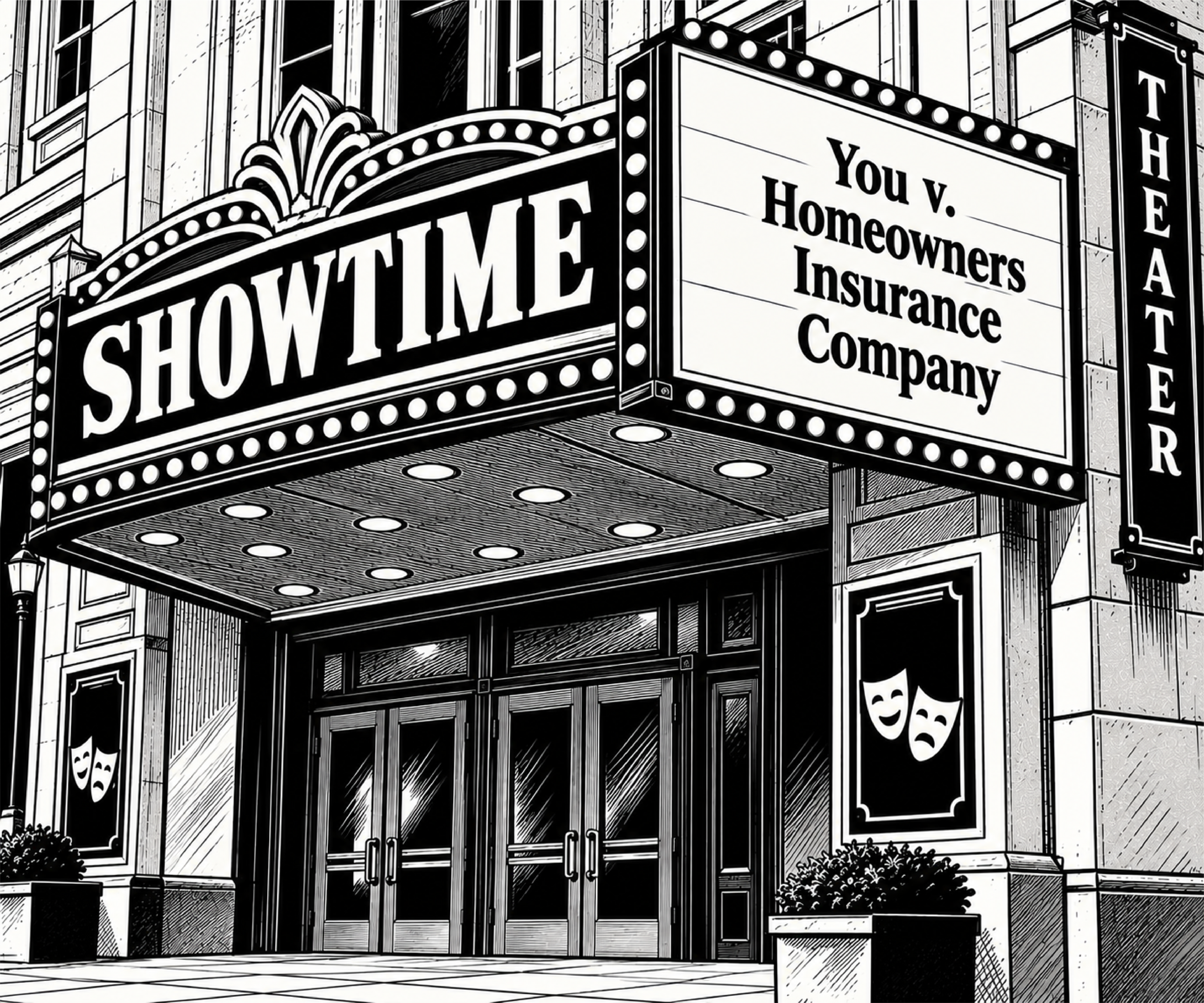
One way to think about a lawsuit is as a theatrical performance.
As the party bringing the lawsuit, you are the lead actor (otherwise called the Plaintiff), and the star of the show. From the moment of the first audition—the first meeting between you and potential counsel—all eyes are on you.
When you begin interviewing potential lawyers, they are not just listening to what you are saying. They are also closely watching and observing you. While listening to your complaints about your homeowners insurance provider, the attorney is trying to weave together a story. That story will ultimately become the narrative and plot of your lawsuit - the theatrical performance.
The potential attorney is also evaluating you as the lead actor. Will you be likeable to a jury? Is your story believable? Will you be coachable? How will you hold up under pressure and cross-examination?
You are auditioning to be the lead actor in a complex theatrical production, and these are some of the many questions going through your potential attorney's mind. While you are evaluating and judging them, they are also evaluating and judging you.
If you select them, your legal team will become your supporting cast. The lead actor and supporting cast will need to get along and work very closely together in order to have success. One of the roles of your supporting cast is to present you and your story to the audience (the Jury) in the most favorable and believable way possible.
The insurance company you sue is called the Defendant. The Defendant is the antagonist in our theatrical production. As the antagonist, they stand in the way of the lead actor's success.
The Defendant's legal team is its supporting cast. Their job is to present a very different story to the audience/jury. They will try to bring down the hero and raise up the antagonist in the eyes of the jury. At a minimum, they will try to convince the jury that the story being told by you, the Plaintiff and your supporting cast is not the whole story, or is not a story they should believe.
The Judge is like the director and moderator of the show. The Judge decides what gets into the show and what does not, including what evidence the audience/jury ultimately gets to see and hear. The Judge also serves somewhat as the narrator, explaining the law and providing instructions to the audience/jury about how they are supposed to decide the case.
In cases brought in Federal Court, you may also encounter a Magistrate Judge. Think of the Magistrate Judge as an assistant director. Depending upon the case, the Magistrate Judge may handle certain pretrial matters, discovery disputes, settlement conferences, and other issues assigned by the trial judge.
While the Jury is the audience, unlike the audience at a traditional theatrical performance, this Jury gets to decide the outcome of the show.
Before the trial begins, the Plaintiff's and Defendant's legal teams participate in selecting the members of the Jury. Jury selection is extremely important because every potential juror enters the courtroom with their own life experiences, attitudes, beliefs, and biases. Both sides are trying to identify jurors who they believe will be receptive to their story, while eliminating potential jurors they believe may be predisposed against you or the Defendant insurance company.
Once selected, the Jury will listen to the competing stories, evaluate the evidence, decide who and what they believe, and ultimately determine the outcome of the case.
The rest of the cast of your theatrical production is the ensemble. The ensemble includes the subject-matter experts that your legal team and the Defendant's legal team may hire to provide opinions and testify about specific issues raised in the lawsuit. When called upon, they step out of the ensemble, provide their expertise to the jury, and then return to relative obscurity.
As the lead actor and star of the show, all eyes are on you, whether during rehearsals or during the live performance itself.
The Judge is watching you. The supporting casts are watching you. The ensemble is watching you as well. And during the live performance, the Jury is carefully watching you and everybody else in the show.
They are observing how people look and act, what they are wearing, what they are saying, and how they are saying it. They are deciding who seems sincere and who does not. Who seems reasonable and who does not. Most importantly, they are deciding who and what they believe.
The law and the facts play an important role in the outcome of every lawsuit. But when it comes to a jury verdict, likeability and believability can be as important as the law and the facts. That is one reason jury trials can be so unpredictable.
Now that you understand the various parties involved in a lawsuit and their respective roles, you should have a better understanding of just how important you are to the success of your lawsuit. But don’t let your importance make you nervous or self-conscious. One of goals of ISMIC's is to help make you a better client. To do that, you need to first understand the role that you play.
And don't worry. There will be plenty of time for rehearsals. Between your legal team and the experts they hire, you will have an entire supporting cast to help you prepare for the grand performance.
One of the decisions that you and your lawyer may make prior to finish in the lawsuit is in which theater to host the production: State Court or Federal Court.
You will not always have a choice. There are legal requirements that must be satisfied before a lawsuit can be brought in Federal Court. And even if you file your lawsuit in State Court, the Defendant may sometimes have the right to move, or "remove" the lawsuit to Federal Court.
When a choice does exist, however, the selection of the theater can be important.
Federal and State Courts operate under different rules (called rules of civil procedure) and can differ in how cases are managed, the jury pool, and how judges are selected.
In California, the name of the entry-level court where lawsuits begin and jury trials take place is called Superior Court (and its judges, Superior Court Judges). In Federal Court in Los Angeles, the name of the entry-level court where lawsuits begin and jury trials take place is called District Court, and in particular the United States District Court for the Central District of California. Judges in Federal Court are sometimes referred to as District Court Judges.
Superior Court Judges serve limited terms and are elected, although many initially reach the bench through appointment by the Governor. Federal District Court Judges are nominated by the President, confirmed by the United States Senate, and generally serve for life.
Historically, Federal Court carried a certain cachet. Federal District Court Judges were perceived as being selected from among particularly accomplished lawyers, and their lifetime appointments were intended to insulate them from prevailing political winds. Unlike an elected State Court Judge, a Federal Judge did not have to worry that an unpopular decision might someday have to be defended in a reelection campaign. For these reasons, Federal Court was considered to be the equivalent of “Broadway” in the theater world, while State Courts were more like “Off Broadway” productions.
Over time, that perceived distinction has become considerably less meaningful. The selection and confirmation of Federal Judges has become increasingly politicized, and judicial philosophy has become the most consideration in the appointment and confirmation process. Whatever perceived advantage Federal Court once enjoyed simply because the person behind the bench was a "Federal Judge," we would not assume today that a Federal Judge will necessarily be better, more capable, or more predictable than a State Court Judge. Today, both Broadway and Off-Broadway shows can be successful or failures. The same is true for lawsuits brought in Federal Court or State Court, from the perspective of the Plaintiff.
While the theater you choose is less important than it used to be, the Judge continues to be a very important cast member in the success of your lawsuit. The particular judge assigned to your case can have an enormous impact on how your lawsuit proceeds and, potentially, its outcome. There are excellent judges in both State and Federal Court. And there are judges in both courts that your lawyer would probably prefer not to draw.
Although you and your lawyer may have some ability to select the theater, you don’t get to pick the Judge. To a significant extent, the Judge assigned to your case is simply the luck of the draw. Regardless of whether you have good luck or bad luck with the Judge assigned to your case, there is little that you can do about it.
You get who you get, so don't get upset.
You are the Plaintiff. The insurance company is the Defendant. As the person bringing the lawsuit, you are called the Plaintiff, the lead actor in our theatrical production. The insurance company you sue is called the Defendant, the antagonist. Get comfortable with these terms. You will hear them throughout your lawsuit.
Your lawyers are your supporting cast. Their job is not only to understand the facts and the law, but also to develop and present your story in the most persuasive and believable way possible.
The Defendant has a supporting cast too. The insurance company's lawyers will tell a different story. Their job is to challenge your version of events and convince the jury that you and your legal team have not proven the story you areasking them to believe.
The Judge is the director. The Judge controls much of what happens in the courtroom, including what evidence the jury gets to see and hear, and instructs the jury on the law.
The Jury is the audience—and gets to decide the ending of the show. Jury selection matters because jurors bring their own experiences, attitudes, beliefs, and biases into the courtroom.
Likeability and believability can be as important as the law and the facts. When jurors are presented with competing stories, who and what they believe can have an enormous impact on the verdict. One party is ultimately perceived to be the hero, and the other as the villain. You start out in the role of hero and you need to fight to maintain that role throughout the production.
The theater doesn’t matter as much as the director. State and Federal Courts have different procedures and different methods for selecting judges, but neither guarantees that you will draw a particular type or quality of Judge.
You generally don't get to choose your Judge. The Judge assigned to your case can have a significant impact on how your lawsuit proceeds and potentially its outcome. In the end: You get who you get, so don't get upset.