

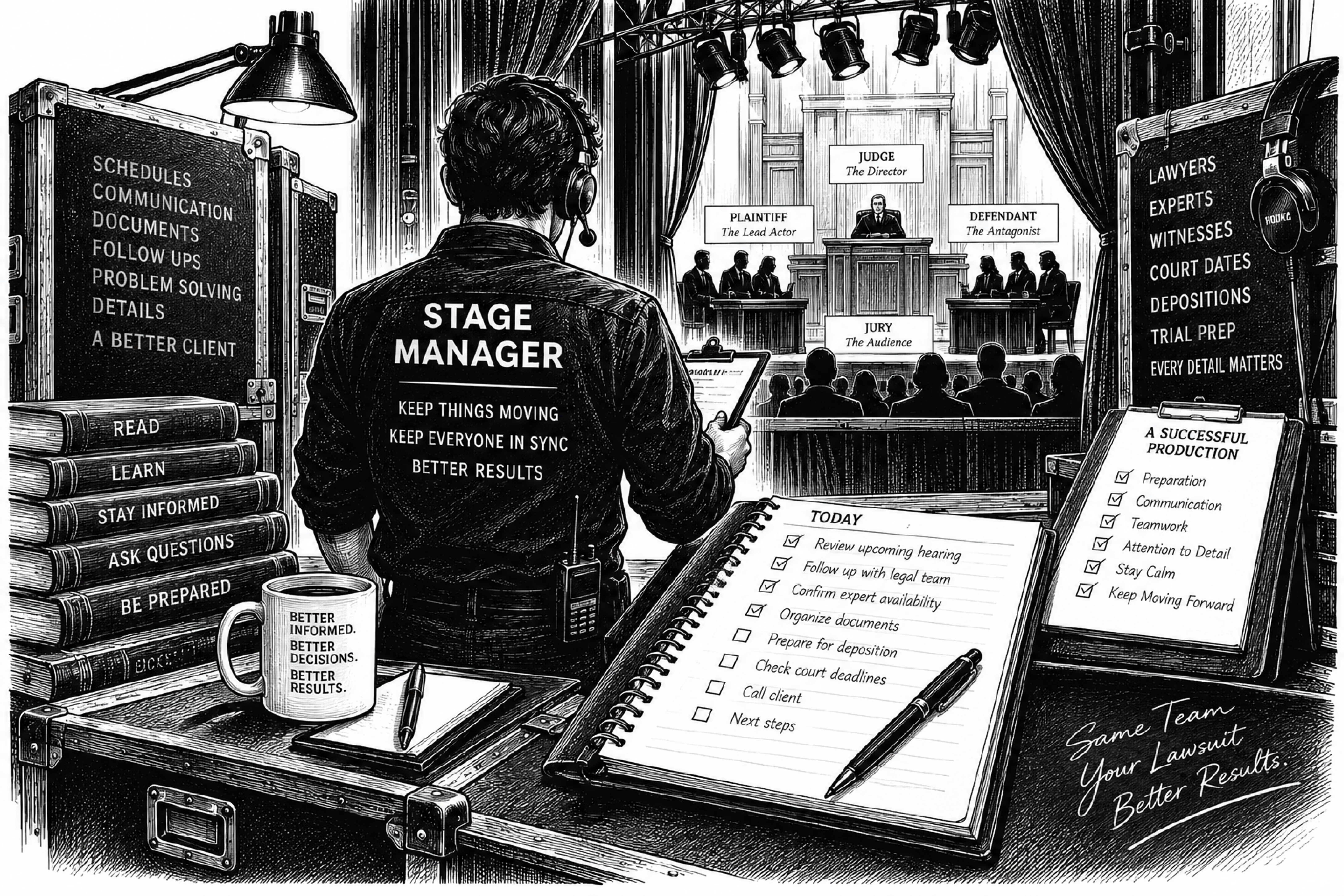
As we explained in Chapter 1 of Series 2 entitled Showtime, as the Plaintiff in this lawsuit, you are the lead character. The star of the show. That is a big responsibility. Most of you have never been a Plaintiff in a lawsuit before. Much of what you see, you will be experiencing for the first time, and much of what you do, you will be doing for the first time.
As intimidating as that may feel to you now, we also explained that you will have a large supporting cast around you to help get you through the process and to make you look good. You’ve hired a team of lawyers who have plenty of lawsuit and trial experience. Through your lawyers, you will have access to a team of subject-matter experts who can be called upon to testify that your homeowners insurance provider acted unreasonably, and to quantify the harm caused to you by the insurance company—a term in the legal world known as damages.
One way for you to proceed with your lawsuit is to rely on the professionals that you have hired, do what they tell you, learn your part, perform when called upon, and sit back and observe the show. That is what most inexperienced Plaintiffs do. And you can choose to go that route as well.
The objective of ISMIC is to make you a better client. If you look at our logo, you’ll notice our tagline: Better Informed. Better Decisions. Better Results. We chose that tagline for a reason.
When people are diagnosed with a serious illness, some people select a doctor, do exactly what the doctor says, and hope for the best. Others become experts on their illness, seek second opinions, research alternative treatments, look for new research on the illness, and take an active role in their treatment decisions.
In medical literature, there is a substantial body of evidence supporting the idea that patients who become experts in their illnesses and take an active role in making treatment decisions have better outcomes than passive patients. In medicine, the phenomenon goes by names like "patient activation," "patient engagement," "patient participation," and "shared decision-making." There is evidence that more activated, informed, and involved patients consistently show better self-management behaviors, better clinical indicators, better care experiences, and often lower costs. The evidence is stronger for some outcomes than others, and much of it is correlational rather than proof of causation.
We are not aware of any similar studies or scientific evidence that supports the notion that Plaintiffs who take an active role in their lawsuits have better outcomes than passive Plaintiffs. But our almost 40 years of active involvement in complex lawsuits has provided enough anecdotal evidence to convince us.
In the Series 1 Chapters of content on ISMIC, we consistently refer to the decision of whether to sue your homeowners insurance provider as “your decision.” In the Series 2 Chapters of content on ISMIC, we consistently refer to the lawsuit as “your lawsuit.” Not the lawsuit. Not the law firm’s lawsuit. Not the lawsuit against your insurance company.
The references to “your decision” and “your lawsuit” are intentional and by design. And they are accurate descriptions.
The ISMIC objective is to give you the beginning knowledge and confidence that you need to become as active a participant as you want to be in your lawsuit. With the exception of the Jury, everybody in the ensemble cast of this production—your lawsuit—including your legal team, your experts, the Defendant, the Defendant’s legal team, the Defendant’s experts, and the Judge, is involved in other lawsuits and will continue to become involved in other lawsuits.
For you, this is it.
You are the one who will live with the consequences of your lawsuit forever. Guaranteed, nobody will care more about, and nobody should care more about, your lawsuit than you do.
For somebody who has never studied acting or acted before, being the lead actor and the “star” of this production is a big responsibility. But that is not the only role that you can play.
The Stage Manager in a theatrical production is a “jack of all trades.” They keep the schedules, act as a link between other members of the cast, help keep the cast and crew calm under pressure, fix broken items, help out during emergencies, and work behind the scenes to make sure everything runs smoothly.
Being the Stage Manager—or at least the Assistant Stage Manager—for your lawsuit is part of becoming a Better Client.
How is it that somebody who has never been the Plaintiff in a lawsuit and knows little or nothing about lawsuits can take on responsibilities similar to a Stage Manager in a theatrical production?
The answers are by reading and re-reading the ISMIC chapters, by doing your own independent research when necessary, and by using Artificial Intelligence.
We live in a world where massive amounts of content are available via the Internet. If you have the curiosity and the desire, you can at least become familiar with complex topics, including issues that come up in your lawsuit, without spending too much time and energy. In addition, Artificial Intelligence can help you sort through the massive amount of information on the topics you want to explore, and the massive amount of information that will be generated by your lawsuit.
We are not suggesting that you use AI to generate legal work product, research legal theories, or cite legal precedent. That is the primary role of your legal team. We are suggesting that you use AI to help manage your lawsuit, uncover facts about the Defendant that might help your lawsuit, help find experts, and check your team’s legal work.
Select a large-language AI agent that you prefer (e.g., ChatGPT, Gemini, Claude, Manus). Sign up for a paid subscription. ADJUST THE SETTINGS SO THAT EVERYTHING THAT YOU ENTER INTO THE AI AGENT AND ALL RESULTS FROM THE AI AGENT REMAIN PRIVATE. THIS IS VERY IMPORTANT.
It is important that documents from your lawsuit remain confidential, and are not accessed by or used to train the AI collective. That is why you need a paid membership and you need to set the privacy setting to that only—not to train the AI collective.
In The Playbill, we introduced you to several documents that will be important in your lawsuit, including the Complaint, Answer, Motions to Dismiss, Discovery, Deposition Transcripts, and Summary Judgment Motions. For the remainder of
this chapter, let’s refer to those documents collectively as “Case Documents”.
At the beginning of the case, the Judge will issue a document called a Scheduling Order (or Case Management Order for State Court). Although administrative in nature, the Scheduling Order is one of the most important documents in your lawsuit. The Scheduling Order sets forth all of the deadlines by which the various stages of your lawsuit e.g., Discovery, Expert Discovery, etc.—need to be completed. Your legal team will have a paralegal or junior associate who will keep track of the deadlines in the Scheduling Order.
If a deadline in the Scheduling Order is missed, it could be catastrophic to your lawsuit.
Ask for a copy of the Scheduling Order. Upload the Scheduling Order to your AI agent. At least once a month, ask your AI agent about upcoming deadlines in the Scheduling Order.
Within whichever AI agent you choose, you should create a project. That project should be your lawsuit. Then take each of The Case Documents (and the responses to The Case Documents) and the Scheduling Order and upload them into the Project. Over time, this will become a knowledge base for helping you manage your lawsuit. As more documents are created and become available, keep uploading them and feeding the knowledge base. The first document you will upload will be the Complaint, or perhaps a draft of the Complaint.
Before uploading attorney-client communications, attorney work product, legal strategy, or other potentially privileged or protected materials, discuss it with your legal team. We discuss privilege and work product in greater detail in Center Stage.
Once you upload the documents, ask your AI agent questions about those documents.
For example, let’s say you upload a draft of the Complaint. Here are examples of questions/instructions you may want to ask the AI agent:
Provide a summary of the Complaint. Explain the Complaint to me in layman’s terms. Explain the causes of action listed in the Complaint. Are the facts alleged in the Complaint sufficient to support the causes of action? Based upon the alleged facts in the Complaint, are there any other claims that can be added to the Complaint? Are these claims typical in homeowners insurance lawsuits?
As to the Scheduling Order, you may want to regularly ask things like: Is there anything else we should be doing in the lawsuit over the next four weeks? Are there any important deadlines approaching? What can I expect to happen next in the lawsuit?
Use the AI agent to answer many of your basic questions and to explain anything and everything to you that you may not understand. We are not suggesting that you use AI to answer questions that you should ask your legal team. We are suggesting that you use AI to educate yourself about your lawsuit and to help determine the questions that you should be asking.
The more documents from your lawsuit that you upload to your AI agent, the better your AI agent will become. Over time, as your AI agent becomes better informed, your AI agent becomes your own personal Stage Manager. And the AI agent can become enormously helpful in assisting you with your Stage Manager responsibilities and in managing your lawsuit.
There are two basic ways to run a lawsuit.
The first way is to be reactive. Being reactive means that you see a deadline in the Scheduling Order approaching and you take action at the last minute to meet that deadline. Or you wait until the other party in the lawsuit files a pleading, and then you react to it.
The second way to manage a lawsuit is to be proactive.
An example of being proactive is putting an aggressive Discovery strategy in place at the beginning of the lawsuit and executing that strategy as soon as Discovery begins. You plan to finish each stage of Discovery well before the deadline in the Scheduling Order, giving your legal team the time and opportunity to make adjustments along the way, if necessary.
In our experience, it is more effective to run a lawsuit proactively rather than reactively.
You also want to bring the fight to the Defendant and send the Defendant a message early and often throughout the case that you mean business and that they better take your lawsuit seriously.
When you are interviewing potential lawyers, you should set their expectations and observe their reactions when you discuss case strategy and management. You should absolutely have the proactive/reactive conversation with them and hear what they say.
If they “roll their eyes” or merely give your proactive strategy suggestions “lip service,” move on to the next firm.
To you, this is not just another lawsuit.
But your law firm will be handling many other lawsuits at the same time as your lawsuit. Law firms do not have unlimited resources. They need to spread those resources among the many cases they are handling.
Think of a law firm as a juggler with multiple plates spinning in the air. Your lawsuit is one of those plates. You want your legal team to keep your plate spinning as fast and as level as possible, instead of only attending to your plate when it begins to slow down and wobble and is about to fall off.
The goal is to make your legal team feel that your lawsuit deserves their continued attention. You want to make certain that sufficient resources are being allocated to your lawsuit to allow your legal team to remain proactive, rather than simply reacting when a deadline approaches or something happens that requires their immediate attention.
There is a fine line between pushing your legal team to be proactive and aggressive, and becoming a pain-in-the-ass.
You want to make your legal team want to do your work.
The best way to do that is for them to like you, respect you, and for you to become easy for them to work with. Your AI agent can be a big help here.
As the star of the show, it is up to you to set the tone. For example, respond promptly to all of your legal team’s requests. Answer their calls and emails the day they are received. Use your AI agent to help you stay current on everything happening in your lawsuit. Demonstrate to your legal team that you are interested, and you care and are on top of everything.
If you are responsive and on top of things, your legal team should be responsive and on top of things. They will follow your lead.
Being liked and easy to work with does not mean you need to become less demanding or a pushover.
If your calls are not being returned or your emails are not being answered, try to find out why. Ask to have a conversation or lunch with the partner in charge of your case and find out what is going on.
If you believe that your lawsuit is not receiving sufficient resources or attention to remain proactive, have a professional conversation with the person in charge of your case. The best way to avoid small conflicts becoming big conflicts is to address them before they become big conflicts.
There is nothing wrong with calling the partner in charge of your case and telling them that you feel you are not getting the attention that was promised. However, that is not a phone call that should be necessary every week, and there are times when you need to remain patient.
As you will learn as your lawsuit unfolds, things don't always go exactly according to plan, and surprises may come up that need immediate attention. That is true for your lawsuit and for the other lawsuits the firm is handling as well. There will be times when emergencies and surprises happen in other cases that divert law firm resources away from your case to more pressing matters.
Don't Be A Whining PIA!
The last thing you want to become is the whining client who complains every time you feel you aren't getting enough attention. However, that is not something that should happen on a regular basis. If it does, you need to speak up—but always in a calm and professional manner.
Although you may be new to lawsuits, chances are you have managed projects or teams of people at some point in your life. Call on those experiences, including what worked and didn't work, and use what you learned in managing your legal team.
While it is easy to simply throw your hands up, claim ignorance about lawsuits and the law, and defer to your lawyer on all decisions, that is not an effective way to manage your lawsuit. That is not being a Better Client.
A Better Client stays informed, knows what is happening now and what should be happening next, knows the right questions to ask, provides constructive criticism when necessary, helps the legal team remain proactive, knows when to push, and knows when to back off.
We are all human and we all make mistakes. Mistakes will happen. Nobody is perfect. But mistakes should be infrequent, and the same mistake should NEVER occur twice.
Know when to be forgiving and when to be tough.
And always say “thank you,” “please,” and be appreciative.
It is your lawsuit. Your lawyers, experts, the Defendant, and the Judge will all move on to other lawsuits. You are the one who will live with the consequences of this lawsuit forever. Nobody will care more about your lawsuit than you do.
You can be more than the lead actor. You can sit back, follow your lawyers’ instructions, and perform when called upon. Or you can also become the Stage Manager—or at least the Assistant Stage Manager—of your lawsuit.
Better informed clients can become Better Clients. The objective is not to become your own lawyer. It is to understand your lawsuit well enough to know what is happening, what should be happening next, and what questions you should be asking.
AI can become your personal Stage Manager. Used properly, an AI agent can help you organize and understand the documents in your lawsuit, keep track of what is happening, identify upcoming deadlines, and help you become better informed.
Get the Scheduling Order and know the deadlines. The Scheduling Order establishes many of the important deadlines in your lawsuit. Ask for a copy. Understand it. Keep track of it. Missing an important deadline can have serious consequences.
Be proactive, not reactive. You want your legal team developing and executing strategies well before deadlines arrive, rather than constantly reacting to whatever happens next. Bring the fight to the Defendant.
Keep your plate spinning. Your lawyers have other clients and other lawsuits. Make sure your lawsuit continues to receive the resources and attention necessary to remain proactive.
You want your legal team to want to work on your lawsuit. Be responsive. Be prepared. Be appreciative. Be easy to work with. But don't confuse being likeable with being a pushover.
Know when to push and when to back off. Not every delay is a crisis and not every mistake is grounds for confrontation. Address recurring problems professionally, recognize that emergencies happen, and don't become the whining client.
Mistakes will happen. The same mistake should not happen twice. Know when to be forgiving and when to be tough. Being a better client requires both.