

How building a detailed timeline that can make or break your insurance lawsuit
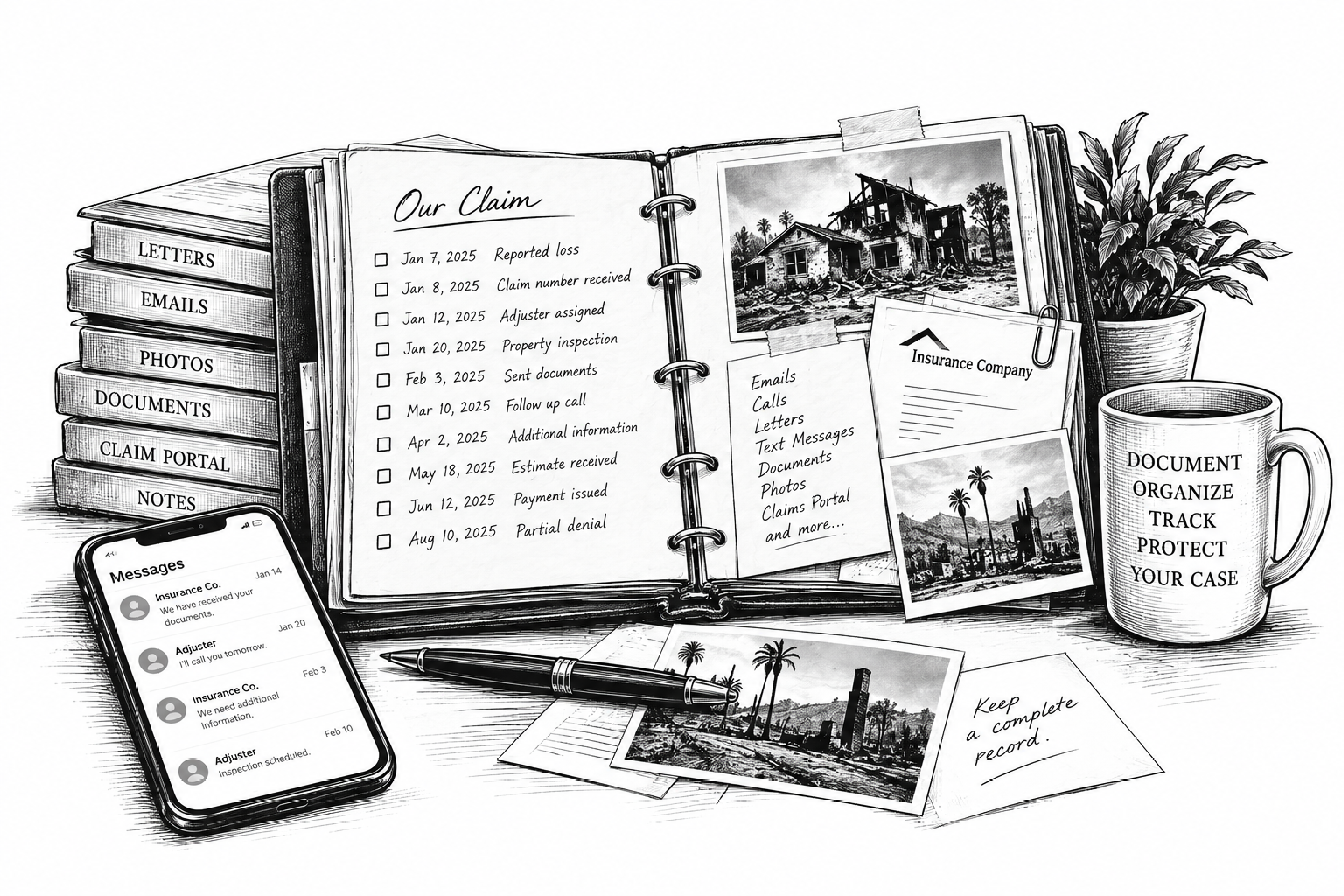
In Chapter 1 called, “Reading the Stopwatch”, we explained why one of the first things you should do after deciding to evaluate a potential lawsuit is prepare a detailed timeline of everything that has happened between you and your insurance company since the loss occurred. We also explained that, in many cases, the only reliable way to determine the applicable deadline—or deadlines—for filing a lawsuit is to first build an accurate timeline of the claim.
Calculating filing deadlines is only one reason to prepare a detailed timeline. A well-prepared timeline also serves several other important purposes that can significantly affect your ability to evaluate, prepare, and ultimately prove your case.
Before discussing those additional benefits, however, it is important to understand exactly what we mean by an accurate and detailed timeline.
By a detailed timeline (sometimes called a chronology), we mean a record of every interaction you have had with your insurance company from the date of the loss to the present. That includes communications by mail, email, telephone, text message, fax, the insurance company's online claim portal, in-person meetings, and any other method of communication.
Think of it as creating a scrapbook of every interaction you have had with your insurance company since you first reported your loss. Assume that each page of the scrapbook is an interaction between you and your insurance company. The end goal is to have as complete of a scrapbook as possible, with as few gaps as possible. You want a third party (e.g. your lawyer) who knows little about your case to be able to read your scrapbook, and understand each stage of your claims settlement process to date. Whether your scrapbook is entirely digital, entirely in hard copy, or a combination of both, is completely up to you.
Start with the date you first reported the loss. Then record every interaction in chronological order. An nteraction includes both written and verbal communications, such as letters, emails, check stubs, checks, direct deposits, payment confirmations, telephone calls, voicemail messages, text messages, and in-person meetings.
For each interaction, record as much of the following information as possible
The date of the interaction.
Whether the communication was incoming or outgoing.
The name and title (if known) of the person with whom you communicated.
The purpose of the communication.
A summary of what was discussed or what the written communication said.
Any documents, photographs, screenshots, or other materials that were sent or received.
Many insurance companies also require policyholders to upload documents through an online claim portal. Each upload—and each response you receive—should be treated as a separate interaction and included in your timeline. Likewise, if your insurance company sends text messages notifying you that an adjuster will be calling, those communications should also be recorded.
Hopefully, you have saved copies of your written communications. If not, go back through your emails, text messages, claim portal, bank records, and telephone records. The goal is to build the most accurate and complete timeline possible.
Once your timeline is complete, you and your attorney will be able to identify the periods during which the "stopwatch" may have been stopped. As we explained in our article discussing filing deadlines, those periods can be critical in determining when your deadline to file a lawsuit expires.
Just as importantly, however, your timeline will often become one of the most valuable pieces of evidence in evaluating whether a lawsuit makes sense in the first place. Patterns begin to emerge. Delays become apparent. Promises can be compared with what actually happened. Missing information is easier to identify. Long before a lawsuit is filed, the timeline often tells the story of the claim.
Your timeline may also reveal patterns that become important later.
For example, California has adopted numerous statutes and regulations governing how insurance companies are expected to investigate and process claims. Although these laws and regulations are generally enforced by the California Department of Insurance—not by individual policyholders—they can nevertheless provide important evidence in an insurance bad faith lawsuit, a subject we will discuss in a separate article.
One pattern we frequently hear about from homeowners is what I refer to as "adjuster musical chairs." The term describes a claim that is repeatedly reassigned from one adjuster to another, often without notice and with little or no continuity.
That was our experience. During the first six months after we reported our loss, our claim was handled by nine different adjusters. Each time we thought we were making progress, a new adjuster would be assigned, requiring us to explain our claim all over again. It often felt like the movie "Groundhog Day", where Bill Murray wakes up and relives the same day over and over.
Insurance companies often explain these changes by saying adjusters are reassigned to respond to catastrophes in other parts of the country. But for a company that wants to operate efficiently, that explanation makes no sense.
Whatever the reason, frequent changes in adjusters can have real consequences. Information may be lost, decisions may have to be revisited, the insured may be forced to repeatedly provide the same documents, and the claim process can slow considerably.
In my opinion, "adjuster musical chairs" is part of the insurers' business strategy. It prevents adjusters from developing a productive working relationship with the policyholder, extending the period during which claims remain unpaid. As we will explore further in our Chapter on insurance bad faith, the financial interests of a homeowners insurance company and the financial interests of its policyholders are often directly at odds. The longer an insurance company holds your money—and the less it ultimately pays—the better the financial result for the insurer.
The California Department of Insurance has also adopted regulations designed to promote fair and efficient claim handling. For example, after more than three adjuster changes within a six-month period, an insurance company is generally required to provide the policyholder with a permanent point of contact. In my experience, this is a requirement that insurance companies frequently ignore.
California's claim handling laws and regulations contain many other requirements governing how insurance companies are expected to investigate, communicate, and attempt to resolve claims.
The purpose of this article is not to review every California insurance statute or regulation. Rather, the point is that an accurate and complete timeline allows an attorney to compare what actually happened during your claim processing with what California law requires. It can quickly reveal delays, repeated requests for the same information, excessive adjuster turnover, missed deadlines, and other patterns that may indicate your claim was not handled properly. In many cases, the timeline becomes one of the most valuable tools for identifying potential insurance bad faith.
Preparing a detailed timeline is one of the most valuable things you can do after a major insurance loss. It will help you understand your filing deadlines, organize thousands of pages of claim documents, identify important patterns in how your claim was handled, and allow an attorney to evaluate your case far more efficiently.
If you decide to pursue a lawsuit, your scrapbook may become one of the most important documents in the entire case. If you decide not to pursue a lawsuit, the process of building the timeline will still give you a much better understanding of what happened during your claim and whether your insurance company treated you fairly.
Build your ‘scrapbook,’ which is a detailed timeline with the date you first reported the loss and every subsequent interaction. Update it after every interaction with your insurance company.
Record every communication, including emails, letters, telephone calls, text messages, claim portal uploads, payments, and meetings
Include copies of every document you sent and received, and link those documents to the corresponding entry in your timeline whenever possible.
Look for patterns, such as repeated delays, adjuster musical chairs” (frequent adjuster changes), requests for the same information, or long periods during which nothing happened.
A well-prepared scrapbook is often one of the first documents an attorney will ask to review—and one of the most valuable tools for determining whether a lawsuit makes sense