

Understanding Insurance Bad Faith
In our Chapter, Building the Scrapbook, we explained that once a claim is filed, the financial interests of an insurance company and its policyholder often become directly opposed. A homeowner wants to recover every dollar to which he or she is entitled—and to receive those benefits as quickly as possible. An insurance company, like every other for-profit business, is financially incentivized to control its costs and increase its profits.
Insurance companies spend billions of dollars each year trying to convince consumers that the company "will be a good neighbor," that they are "on your side," or that you are "in good hands." Those advertisements are highly personal. They are designed to create the impression that, if disaster ever strikes, your insurance company will stand beside you.
Unfortunately, after a catastrophic loss, many policyholders discover that the claims process feels anything but personal.
For our claim, it quickly became apparent that many of the significant decisions affecting payment were not being made by our individual adjuster. Numerous policyholders throughout our community received remarkably similar settlement offers, encountered remarkably similar delays, and were given remarkably similar explanations for why their claims were not progressing. Whether those decisions were made at the regional level, the corporate level, or somewhere else within the company, we do not know. What we do know is that many policyholders experienced strikingly similar claim handling and, in our experience,
adjusters often appeared to be reading from the same script.
I make this point not simply to criticize insurance companies, but to emphasize something that took me months to understand. Your frustration is real, but try not to take the way your insurance company is treating you personally. Many of the decisions affecting your claim may have little to do with you or your specific claim and instead reflect broader claim-handling decisions made by the insurance company. It is difficult to do, but try to view your claim through a business lens rather than purely an emotional one. Hopefully, that perspective will help you make better decisions as your claim progresses.
Most contracts are subject to what lawyers call the Implied Covenant of Good Faith and Fair Dealing. While the name sounds complicated, the underlying principle is fairly simple. A contract is more than words contained in a document. The law expects each party to act in a manner that does not unfairly interfere with the other party's ability to receive the benefits of the agreement. A homeowners' insurance policy (together with its endorsements) is a contract between the insurance company and the policyholder.
California courts have long recognized that the relationship between an insurance company and its policyholder is fundamentally different from an ordinary business relationship.
Think about the relationship between a parent and a child. Because the parent possesses far greater physical, emotional, financial, and decision-making power, the law imposes special duties upon the parent and provides additional protections for the child. Those protections do not exist because every parent behaves improperly. They exist because the relationship itself involves a significant imbalance of power.
California insurance bad-faith law is based upon a similar principle. When a homeowner suffers a catastrophic loss, the insurance company has vastly greater financial resources, vastly greater knowledge of the claims process, and substantially greater leverage than the policyholder. Recognizing that unequal relationship, California courts have interpreted the Implied Covenant of Good Faith and Fair Dealing to impose duties upon insurance companies that extend beyond the express language of the insurance policy.
In California, violations of those duties have come to be known as insurance bad faith. Insurance bad faith can take many forms, and every situation is different. Whether particular conduct qualifies as insurance bad faith depends upon the specific facts and circumstances of each case. Nevertheless, common examples of claims-handling conduct that may constitute insurance bad faith include:
Unreasonably delaying the investigation of a claim;
Unreasonably delaying payment of benefits owed under the policy;
Failing to conduct a prompt, fair, and thorough investigation;
Failing to adopt and implement reasonable standards for investigating and evaluating claims;
Ignoring or failing to consider evidence supporting the policyholder's claim;
Misrepresenting policy language or available insurance benefits;
Misrepresenting facts relating to coverage or the value of a claim;
Failing to provide a reasonable explanation for denying or limiting benefits;
Failing to affirm or deny coverage within a reasonable time after receiving sufficient information;
Making settlement offers that are unreasonably low without a reasonable basis;
Interpreting policy provisions in an unreasonable manner to reduce or avoid payment;
Requiring unnecessary or repetitive documentation for the purpose of delaying payment;
Repeatedly transferring a claim between adjusters in a manner that unreasonably delays resolution;
Failing to reasonably communicate with the policyholder during the claims process;
Looking for reasons to deny or reduce a claim rather than attempting to determine the benefits owed under the policy;
Compelling a policyholder to file a lawsuit to recover benefits that should have been paid voluntarily;
Using delay or financial pressure to force a policyholder to accept less than the reasonable value of the claim; and
Not giving at least as much consideration to the interests of the insured as to its own interests.
That last example is particularly interesting. Because of the unequal bargaining power between an insurance company and a policyholder, especially after a catastrophic loss when many policyholders are emotionally, financially, and physically exhausted, California law requires that an insurance company give at least as much consideration to the interests of its insured as it gives to its own interests. That is a tall order and is emblematic of the special relationship recognized by the California courts. An insurer is not permitted to take advantage of the unequal bargaining power that exists during the claims process, including the fragility and desperation that often accompany a catastrophic loss.
While the above examples are real, it is important to understand that insurance bad faith is generally not established merely because an insurance company made a mistake or because the parties disagree about coverage or the value of a claim. Insurance companies are entitled to make reasonable mistakes and to have legitimate disputes regarding claims. Insurance bad faith only arises when the insurance company acts unreasonably. If you decide to move forward with a lawsuit, your lawyer will guide you on whether the insurer's conduct likely rises to the level of insurance bad faith.
Imagine you pull into a parking space where the meter costs one dollar per hour. Because you are only running into a store for a few minutes to make a return, you decide not to pay the dollar. If there is a parking ticket on the window when you return to the car, you don't simply owe the one dollar you could have paid before leaving the car. Instead, you owe an amount that is many times greater because you didn't follow the rules.
"Insurance bad faith works in a similar way as the parking ticket."
If you are not paid what you believe you are owed under the policy, decide to sue, and ultimately prevail, the insurance company should not only have to pay what it originally owed you under the policy. If you also prove that the insurance company acted unreasonably, it may also be required to compensate you for the
additional harm its unreasonable conduct caused. That is what California's insurance bad-faith law is designed to accomplish.
The Main Course
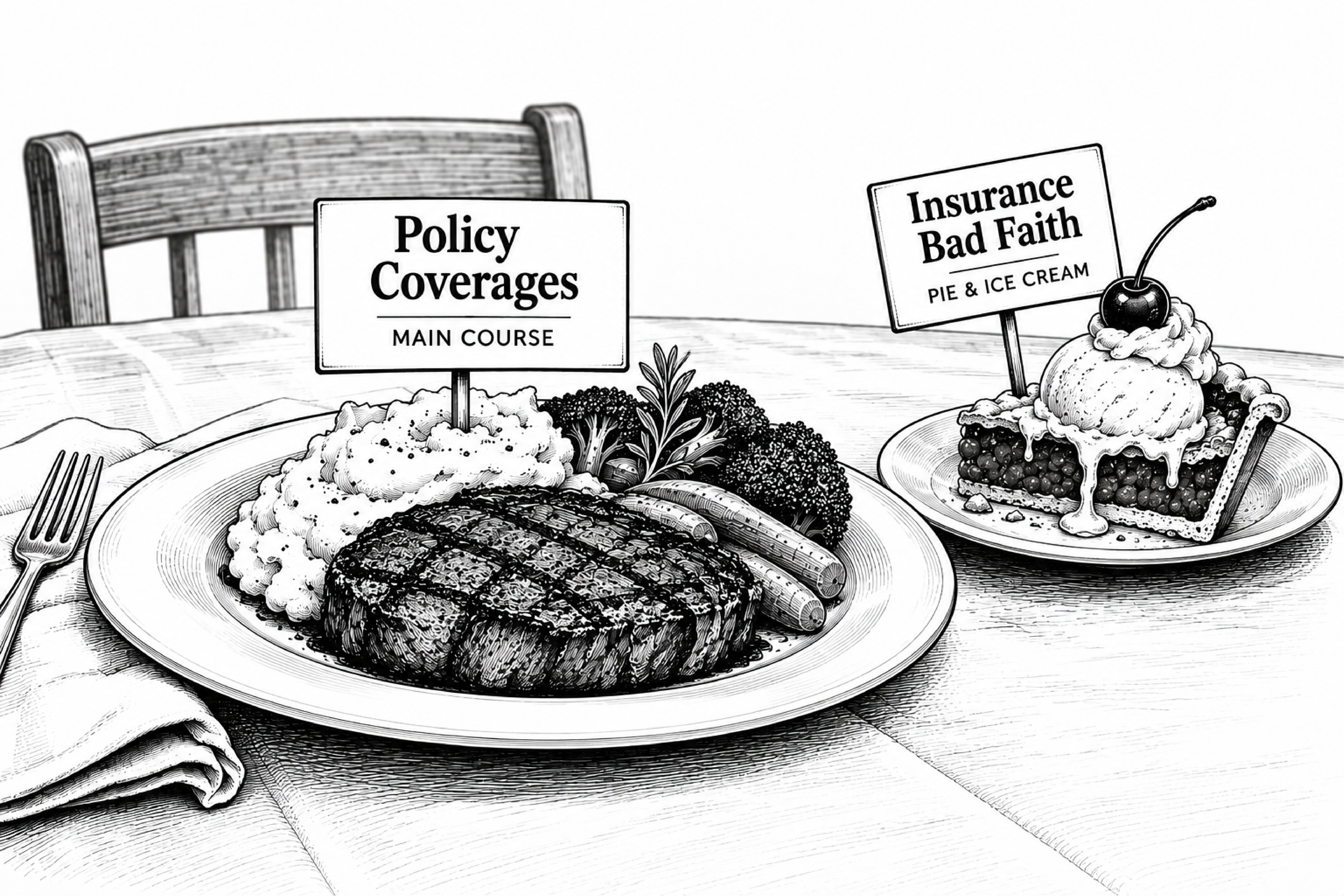
Think of the insurance benefits promised by your policy as the main course of a meal. Those benefits are what you purchased and what your insurance company promised to provide. If the insurance company failed to live up to provisions of the insurance contract, they may be liable for breach of contract.
The additional damages that may be available in a successful insurance bad-faith case go beyond the benefits under the policy. Think of them as the "Pie and Ice cream". They exist not because the insurance policy promised them, but because California recognizes that policyholders deserve additional protection when an insurance company abuses the unequal relationship that exists during the claims settlement process.
If you ultimately decide to sue your insurance company, your objective should not only be to recover everything that you were originally owed under the policy—the main course. If the insurance company acted unreasonably, you should also seek to recover as big of a piece of desert that California law allows. It is about recovering the entire entre that you paid for, together with every bit of desert that California law permits.
Once a claim is filed, the financial interests of the insurance company and its policyholder often become directly opposed.
California recognizes that the relationship between an insurance company and its policyholder is different from an ordinary business relationship and therefore imposes additional duties upon insurers.
Violations of those duties may constitute insurance bad faith.
Insurance bad faith can take many forms, including unreasonable delays, inadequate investigations, misrepresentations, and placing the insurer's interests ahead of those of its policyholder.
Insurance bad faith is highly fact-specific. Individual acts that may seem insignificant in isolation can become much more important when viewed as part of the overall handling of a claim.
If insurance bad faith is established, a policyholder may be entitled to recover damages beyond the benefits promised by the insurance policy. While the breach of contract claim may be the main course, insurance bad faith can be like a healthy slice of pie.
Throughout this article, we treated the contract benefits promised under your insurance policy as the main course, and the potential damages available for the unreasonable handling of your claim (insurance bad faith) as a large desert.
Many policyholders assume they are entitled to only one main course.
Depending upon the specific facts of your case, however, you may be entitled to a second main course, as well as more desert.
In our next Chapter, In Search of More Food, we'll explore underinsurance, a second main course that is often overlooked by policyholders and their lawyers. Later in the series, we will discuss other potential harms to look for that may possibly added to your lawsuit, depending on the facts of your case. Why just eat plain pie for desert, when you can have a scoop of ice cream on top?