

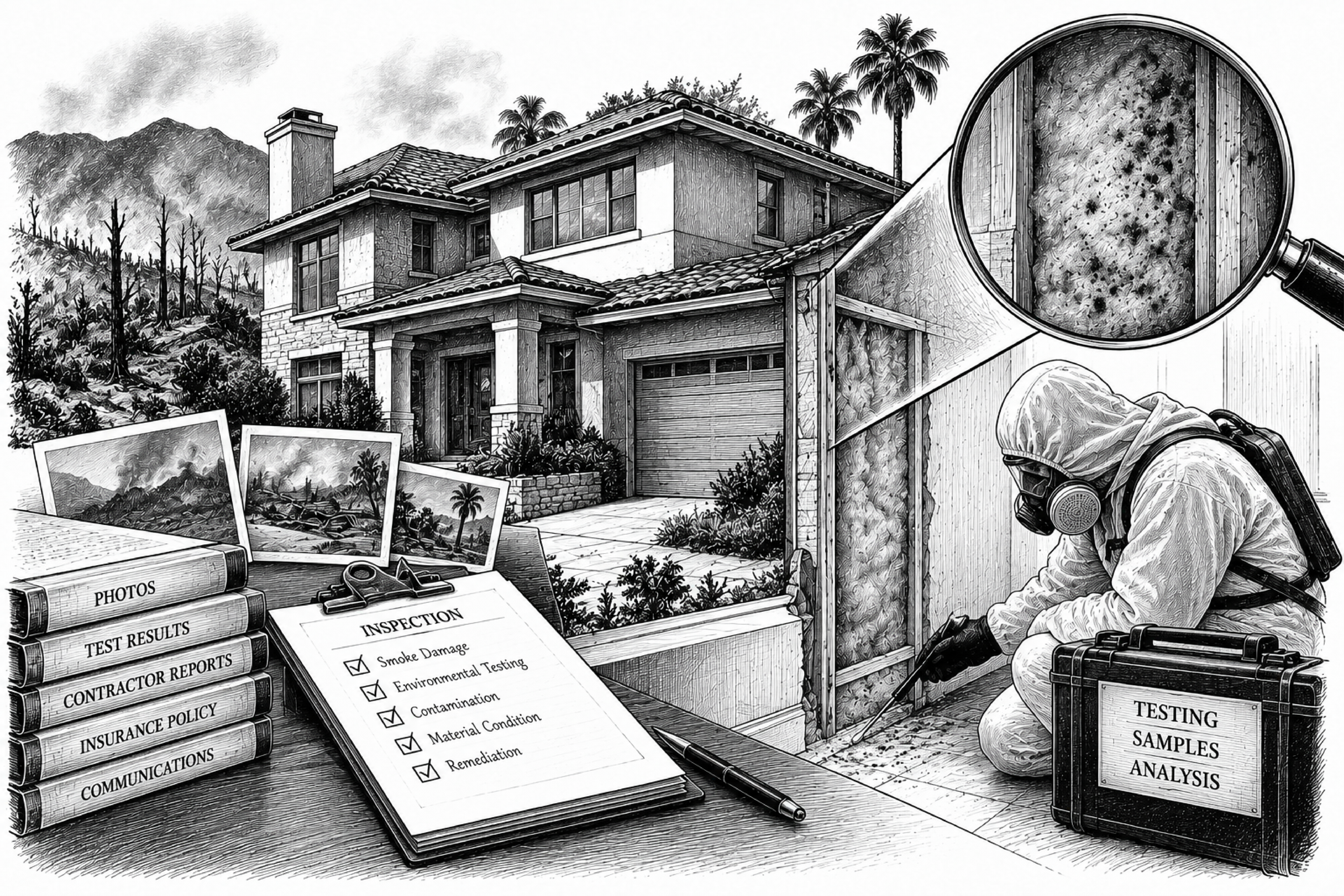
If the structure of your house “survived” the wildfire—meaning it was not physically destroyed—but your house or personal belongings sustained smoke, environmental, or other damage, many of the concepts that we have introduced in this Series 1 of Chapters may equally apply to you.
But because the structure of your home survived, there are some unique issues that you should consider when deciding whether to pursue a lawsuit.
The purpose of this Chapter is to help identify those issues.
In our Chapter entitled Reading the Stopwatch, we explained that because the California Governor declared a state of emergency, the filing deadline for a lawsuit is generally two years after the fire, with the clock potentially paused during certain periods while the insurance company is investigating the claim.
For homeowners dealing with smoke damage or environmental contamination, however, there may be an additional wrinkle.
Assume that approximately one year after the fire, you discover that the insulation in your house contains high levels of lead or other heavy metals associated with the wildfire. When did the clock begin to run? On the date of the fire? Or when you discovered—or reasonably should have discovered—that the insulation had been contaminated?
California law generally measures the deadline from the “inception of the loss.” But determining when a loss began can become more complicated when damage was not immediately apparent. The question can include when appreciable damage occurred and when you knew, or reasonably should have known, that the damage existed.
ISMIC's advice is simple: Don't bet your lawsuit on winning that argument.
Be conservative. Assume that your clock began running on the date of the fire and make your decisions accordingly. But if you discover significant smoke or environmental damage later, don't automatically assume that you are out of time. Depending upon the particular facts, you may have more time than you think.
Damage to the structure of your house—including smoke and environmental damage— would generally fall under your Dwelling coverage, commonly referred to as Coverage A.
In California, the fact that your house is still standing does not necessarily mean that you have any less of a right to coverage than you would have if flames destroyed the dwelling.
The issue becomes whether the evidence establishes a distinct, demonstrable physical alteration or impairment of the property.
That sounds like a lot of legalese. So let's convert it to English.
The damage does not have to be visible or structural for you to have a claim.
For example, if contaminants from the wildfire infiltrated your drywall or insulation so that those materials are no longer suitable for their intended purpose—because, for example, they are no longer safe to remain in your house—your Dwelling coverage may cover the cost of remediating or replacing those materials and restoring your home.
There are four important things to look for:
Physical infiltration. The contamination has infiltrated the material, rather than simply sitting on its surface.
Causation. There is evidence linking the contamination to the wildfire.
Material-specific unsuitability. The contamination has affected the particular material so that it is no longer suitable for its intended purpose. Drywall, for example, is no longer safe to use as drywall.
Routine cleaning isn't enough. Surface cleaning or other routine cleaning will not return the affected material to its pre-loss condition.
Documentation becomes extremely important. What materials are affected? What contaminants are embedded in them? How does the contamination prevent those materials from being safely used for their intended purpose? Why isn't surface cleaning sufficient to return them to their pre-loss condition?
One of the problems is that California law does not prescribe a particular type of environmental testing—or a particular number or frequency of tests—that your insurance company must perform.
Everything is fact-dependent. It comes down to what a reasonable investigation requires based upon the known facts.
Based upon how many insurance carriers treated their customers after the fires, it appears that “reasonable” is not a term that every insurance company acknowledges or understands.
If you are unhappy with how your smoke damage or environmental claim was handled and are considering a lawsuit, ISMIC applies to you too.
When it comes to Building the Scrapbook, the same rules apply whether your home was destroyed or whether it remained standing but sustained smoke, environmental, or other damage.
You want to chronicle every interaction that you have had with your insurance company.
Did you request environmental testing? How did the insurance company respond? How much testing was performed, and who paid for it? Who selected the testing company? What was tested? How many times was testing performed, and at what intervals? What did the testing show? What did the insurance company do after receiving the results?
These are just a handful of the issues that could become relevant to an insurance bad faith claim in a potential lawsuit.
Environmental testing can become expensive.
That raises an obvious question: Who should pay for it?
The California Department of Insurance has taken the position that when professional testing is warranted, the insurance company should contract and pay for it. The Department has also indicated that it can be unreasonable to require an insured to incur substantial costs to independently investigate a claim.
That does not necessarily mean that your insurance company must reimburse every environmental expert or every test that you independently decide to order.
But if you believe professional testing is warranted, request it from your insurance company in writing.
If the insurance company refuses, conducts testing that you believe is inadequate, or reaches conclusions that you believe are unsupported, you may decide to retain your own qualified environmental professional.
And, of course, put all of that in your Scrapbook.
Who requested the testing? Who refused it? What testing did the insurance company perform? What did your expert recommend? What did the insurance company do with those recommendations?
If you eventually pursue a lawsuit, those questions may become important.
When it comes to the list of your personal belongings, you may have a different problem than insureds whose belongings were completely destroyed. See Chapter 5 – The F’ing List.
For you, the hard part isn't remembering all of the things you used to own. They are probably still sitting right in front of you.
Instead, the fight may be convincing the insurance company that those items need to be replaced—or, at a minimum, professionally cleaned if they can be restored to their pre-loss condition.
We know of one person who had a very expensive collection of handbags that were severely damaged by smoke.
After months of negotiation, the insurance company finally agreed to reimburse the insured for the replacement cost of the handbags.
But there was a catch.
In order to receive the replacement money, the owner had to turn over all of the damaged handbags to the insurance company.
Those smoke-damaged handbags were eventually listed for sale on eBay.
As strange as that may sound, requiring an insured to surrender damaged property after the insurance company pays to replace it is not uncommon.
That may mean your insurance company will resell your damaged property. So don't be surprised to see your damaged items listed for sale.
When it comes to Additional Living Expenses, for homes in need of remediation, or ALE, our Chapter entitled Living in an Alternative Universe is as applicable to you as it is to someone whose house was completely destroyed.
In theory, it should take less time to remediate or repair a home that has smoke and/or environmental damage than it does to rebuild a new home. But based upon the pace at which some insurance companies are handling these claims, that may not necessarily be the case. For that reason, your ALE coverage may be inadequate to pay for alternate housing while you are waiting for your home to be made safe for occupancy. If your ALE has run out—or is running out—see our Chapter entitled In Search of More Food. In addition to a potential insurance bad faith claim, you may also have an underinsurance claim.
This may be the most important question of all.
Is your house safe to live in?
Unfortunately, there isn't a simple test that provides a universal answer.
California does not have a single legally established post-wildfire contamination level that determines whether a house is “safe” or “unsafe” for occupancy. There is no universal testing protocol, clearance number or laboratory result that automatically answers the question.
And there is good reason to take the question seriously.
Testing following the Palisades and Eaton Fires has identified potentially dangerous contaminants associated with wildfire smoke, ash and debris, including heavy metals, volatile organic compounds and so-called “forever chemicals.” Smoke and the chemicals contained in it can also penetrate a house and interact with its contents and building materials.
Porous materials such as drywall, insulation, carpeting, furniture and other materials can absorb or retain contaminants. Those contaminated materials and surfaces can potentially become continuing sources of chemicals released back into the indoor environment.
In other words, the fire can be out and the outside air can appear clean while something inside your house continues to release contaminants. That also helps explain why testing can become complicated. A test is a measurement of conditions at a particular place and time. What was measured? Where was the sample taken? Was the air tested, or were surfaces and building materials tested? What about the attic, insulation, HVAC system, drywall or other porous materials? What contaminants were included in the testing?
And what was “safe” on one day may not necessarily tell you everything about conditions on another day. This becomes particularly important when an insurance company relies upon limited testing to tell you that your house is safe to occupy.
California law does not prescribe one particular testing protocol, number of samples or testing frequency that an insurance company must use following a wildfire. The question is whether the investigation was reasonable based upon the particular facts.
There is another important distinction. “We didn't find anything in this test” is not necessarily the same thing as “your house is safe.” If you have concerns about whether your home is safe to occupy, this is an area where qualified environmental professionals can be extremely important. You want to understand not simply the test results, but what was tested, what wasn't tested, where it was tested, when it was tested, and what conclusions the testing can reasonably support. And if your insurance company told you that your house was safe based upon testing that you believe was inadequate, put all of that information in your Scrapbook.
If you ultimately decide to sue, the question may not simply be whether your house was contaminated. It may also be whether your insurance company conducted a reasonable investigation before telling you that it wasn't.
People whose houses are still standing are by no means “lucky.”
They merely have a different set of problems.
The commonality is that they need to rely upon their homeowners insurance carrier to help solve those problems.
Reports following the Palisades and Eaton Fires have indicated that insureds whose homes are still standing have experienced many of the same claim-handling problems with their homeowners insurance carriers as people whose homes were completely destroyed.
Their houses may still be standing. But that doesn't mean their insurance claims have been any easier.
If your home is still standing and you are unhappy with the way your insurance claim was handled, ISMIC is here for you too.
Just because your house is still standing does not mean that you did not suffer a significant insured loss.
Smoke and environmental damage to the structure may fall under Coverage A even when the damage is not visible or structural
For embedded contamination claims, focus on physical infiltration, causation, whether the affected material remains suitable for its intended purpose, and whether ordinary cleaning can restore it to its pre-loss condition.
California does not prescribe one universal post-wildfire testing protocol or one standard that determines whether a home is “safe.”
Keep the same Scrapbook. Document every request for testing, every test performed, every result, every insurer response and every disagreement over remediation.
If professional testing is warranted, ask your insurance company in writing to pay for it.
If your personal belongings survived, your problem may not be remembering what you owned. It may be proving that contaminated items need to be cleaned or replaced.
ALE can be just as important for a standing home as for a destroyed home. If your ALE is running out, revisit the Chapter entitled In Search of More Food.
Don't assume that later-discovered contamination automatically gives you more time to sue. Be conservative and assume your filing clock began with the fire unless your lawyer tells you otherwise.
A house can be still standing and still leave its owners with a very serious insurance problem.