

Other Rescue Options?
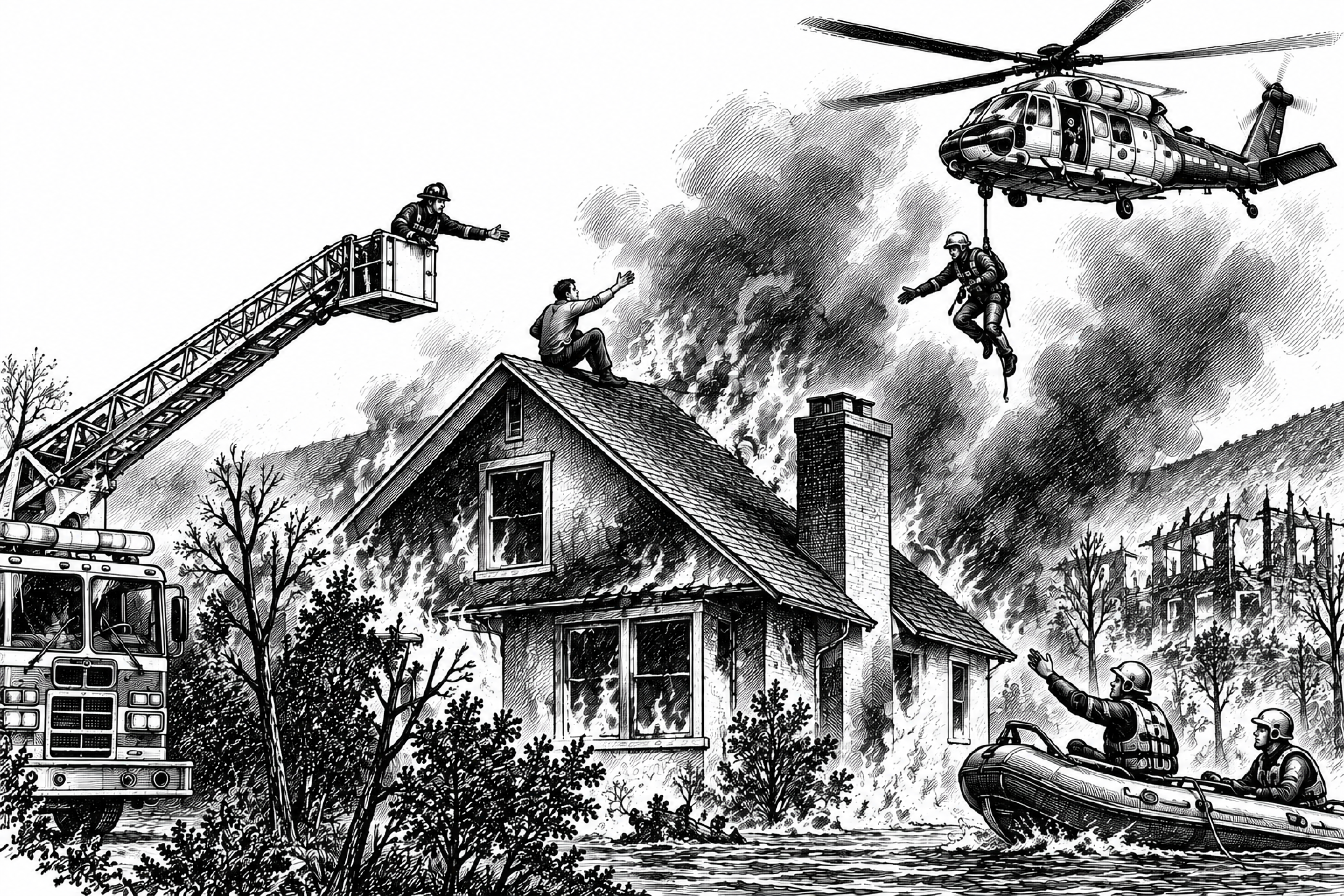
Filing a lawsuit is not the mere option available to a policyholder who is unhappy with the handling of a homeowners insurance claim. Before filing a lawsuit, there are several alternatives worth considering, or perhaps trying before litigation.
They include escalating the claim within the insurance company, hiring a public adjuster, filing a complaint with the California Department of Insurance, and contacting local or state representatives.
When it comes to the payment of claims, homeowners insurance companies are masters at employing a strategy that textbooks would describe as “diffusion of responsibility,” “bureaucratic layering,” or “siloing.” The term ISMIC prefers is strategic obfuscation.
Strategic obfuscation occurs when an organization makes a process deliberately complex, unclear, and hard to navigate, and gives front-line employees so little authority and so little knowledge about the inner workings of the company that they can’t make a mistake. Homeowners insurance companies will tell you that this is merely a system of “checks and balances” designed to protect the company and its assets.
But the behavior goes well beyond that.
As an initial matter, one can argue that homeowners insurance companies deftly employ a maze of procedures, fine print, and split authority to intentionally confuse, exhaust, or discourage you until you become so frustrated that you ultimately just give up. They spread decision-making authority so thinly that when a mistake is made, the company can claim it was a “systemic communication breakdown” rather than the fault of any single employee. This is a concept known as plausible deniability.
And by keeping you in the dark about who actually holds the power to approve your claim, they make it nearly impossible for you to hold anyone accountable.
This strategic obfuscation is not only helpful to the homeowners insurance company in a claim settlement setting. It can be equally effective at protecting the company if a lawsuit is filed.
Think about it like a spy movie where a team of spies is deployed to a hostile country to engage in a secret master plan of espionage. Each spy is told barely enough detail to complete their part of the mission. Nobody accessible to the enemy knows the entire plan, so that if a spy gets caught, they can only reveal the little they know, and not the entire plan.
In our example, the lower-level claims personnel are the spies.
Homeowners insurance companies use titles for customer-facing claims personnel like Property Adjuster, Claim Owner, Claim Specialist, Estimator, Manager, Claim Handler, and Team Leader. And they constantly rotate the people assigned to your claim.
This makes it very difficult to determine who to depose once a lawsuit is filed and substantially decreases the risk to the insurance company that any person who is deposed will say anything damaging to the company.
In our experience, personnel at the claims-adjuster level have no authority to make substantive decisions. They are merely note takers and messengers who are closely scripted and have little knowledge about the inner workings of the company.
Asking to talk to a “supervisor” or a person with decision-making authority is also usually an exercise in futility. We even wrote to the CEO of State Farm, and received no response.
From what we have learned, dollar-payment decisions, particularly decisions exceeding relatively low payment amounts, are often made by higher-level executives within the company to whom you have no access. And for payment decisions involving large amounts of money—for example, $1 million or more—we have been told that sign-off could be required by somebody at the parent company of the operating entity, especially when the parent company is also acting as a reinsurer.
Somewhere at the very upper levels of the insurance company, or maybe even at the parent company, there is at least one person, or perhaps a committee of people, who stay hidden behind a curtain and pull the levers and push the knobs with the hope of scaring away any brave souls who dare to discover or question their claims-payment practices.
As covered in the Series 2 Chapter “The Script,” the insurance company always wants to protect itself by characterizing your lawsuit as a one-off claim dispute, as opposed to an institutional failure or systemic misconduct. By giving lower-level personnel no authority and limited information, and cutting off access to anybody at the higher levels of the company with decision- making authority, the obfuscation strategy can be very effective.
Before filing a lawsuit, you and your lawyers should discuss a strategy—or strategies—for identifying the wizzard and lifting the curtain of obscurity.
A public adjuster is hired by and represents the policyholder—not to be confused with the insurance company’s adjuster. California public adjusters are licensed and regulated by the California Department of Insurance. An individual generally must satisfy licensing requirements that include an examination, background check, and fingerprinting.
A good public adjuster knows how property claims work, understands the claims adjustment process, and should know the details of the insurance policy. A public adjuster can assist you with much of the administrative work that we outline in Chapters 2 through 5 of this Series. They can also communicate with the insurance company on your behalf.
Overall, one of the principal benefits of hiring a public adjuster is helping to equalize the information imbalance between what the insurance company knows and what you know.
But that is also one of the principal purposes of ISMIC.
In Chapters 2 through 5 of this Series, we show you how to do much of the administrative work yourself. We explain how to organize and document your claim, understand what your insurance company is doing, and become a better-informed participant in the claims adjustment process.
A public adjuster also cannot circumvent the strategic obfuscation used by insurance companies to delay payments, limit accountability, and prevent access to decision-makers with authority. Public adjusters are generally forced to work with the same lower-level claims personnel that you, as the policyholder, would work with.
For their services, public adjusters can be paid as much as 30% of the insurance proceeds that they assist in collecting. The specifics of the fee—and, importantly, what insurance proceeds the fee applies to—are subject to negotiation and the fee agreement.
Before signing a retainer agreement, make sure you understand exactly what the public adjuster is going to do for you, what you are still going to have to do yourself, and exactly which insurance proceeds will be subject to the adjuster’s fee. All of that is subject to negotiation and should be carefully spelled out in the retainer agreement.
In Series 2, Chapter 3, “The Stage Manager,” we introduce the possibility of using a large-language-model AI agent to help manage your lawsuit in the event you decide to sue. But an AI agent can also be used much in the process to help equalize the information imbalance between you and your insurance company, particularly when it comes to understanding your policy and its coverages.
After filing a claim, California law requires the insurance company to provide you with a copy of your insurance policy and its endorsements.
Endorsements are additional policy provisions that are not included in the main body of the policy.
Early in our claims-adjustment process, we scanned both the policy and the endorsements and uploaded them to a large-language-model AI agent such as ChatGPT, Claude, or Gemini. Once the information is uploaded, you can ask the AI agent coverage questions. You can also ask the AI agent to explain your coverages in easily understandable terms.
Between ISMIC, the internet, and AI agents, there are easy and certainly less expensive ways of helping to bridge the information gap between you and your insurance company than paying a public adjuster a substantial percentage of the insurance proceeds you receive.
None of that means that a public adjuster has no value.
In certain situations, there may be a role for a public adjuster. But that role, along with the compensation, should be tightly defined.
Before hiring a lawyer, we filed a complaint with the California Department of Insurance (DOI).
It was absolutely no help.
California has some of the most aggressive and consumer-friendly insurance laws and regulations in the country. The problem is that many of those protections are only as good as the mechanisms available to enforce them. And the enforcement record is atrocious.
For many California insurance laws and regulations, there is no private cause of action that allows the policyholder to sue the insurance company simply because it violated the rule. Although violations of insurance rules and regulations may, in some cases, be used as evidence of insurance bad faith, the only entity with the authority to directly enforce those rules and regulations is the DOI itself.
In our lawsuit, we alleged violations of 17 different California insurance laws and regulations. And without meaningful DOI enforcement, the rules have little deterrent effect.
Consider the DOI's recently announced enforcement action against State Farm arising out of its handling of claims from the Pacific Palisades and Eaton fires.
The DOI examined a sample of 220 State Farm claims and found 398 violations of California insurance rules and regulations in 114 of the claims.
More than 50% of the claims had at least one violation. The DOI found delayed investigations and payments, unreasonably low settlement offers and underpayments, repeated adjuster reassignments, improper handling of smoke-damage claims, misrepresentation of policy provisions, and inadequate communications.
Based upon that sample, the DOI concluded that potentially thousands of wildfire survivors may have suffered similar violations. The California DOI itself concluded that these violations were likely systemic.
California law permits penalties of up to $5,000 for each violation and up to $10,000 for each willful violation. The DOI's enforcement action alleges the 398 violations uncovered in the sampled claims, plus another 34 violations arising from consumer complaints. If every one of the 432 alleged violations identified by the DOI were ultimately determined to be willful and assessed at the statutory maximum, the potential penalty against State Farm would be approximately $4.3 million.
The DOI described the penalties it was pursuing as “the largest amount pursued this century following a wildfire disaster.”
Unfortunately, $4.3 million fine isn't even a slap on the wrist for a multi-billion dollar insurance company..
An incurance might pay more than $4.3 million to settle a single significant civil lawsuit. How much deterrence does a potential $4.3 million regulatory penalty provide to an insurance company the size of State Farm?
We understand that the DOI cannot possibly investigate every insurance claim filed after a major catastrophe. That is why it uses sampling.
But the State Farm investigation raises an obvious question. The DOI examined 220 claims and found 398 violations, approximately 1.8 violations for every claim it examined. State Farm had approximately 11,300 residential claims arising from the Palisades and Eaton fires.
If the violation rate found in the DOI's sample were statistically extrapolated across those approximately 11,300 State Farm residential claims, it would translate to roughly 20,000 potential violations.
At the existing statutory maximum of $5,000 per violation, that would represent potential penalties of approximately $100 million. If the violations were willful and subject to the $10,000 maximum, the potential penalties could approach $200 million.
A $200 million fine would at least get the attention of State Farm and other California insurers.
To be clear, the DOI did not find 20,000 violations. That number is simply an extrapolation of the violation rate the DOI found in its sample. Any actual extrapolation would have to employ an appropriate statistical methodology and be legally permissible.
But consider the apparent inconsistency.
The DOI is willing to use the results of its sample to conclude that State Farm engaged in a pattern of unlawful conduct that potentially affected thousands of wildfire survivors. Yet, in its announced enforcement action, the penalties being pursued are only based upon the violations actually identified in the sampled claims and through consumer complaints.
If a statistically valid sample can be used to conclude that potentially thousands of policyholders were affected, why shouldn't an appropriate statistical methodology also be available to determine a penalty that reflects the potential magnitude of the misconduct?
There is another problem. Even if the DOI successfully imposes penalties against an insurance company for violating California insurance laws, the policyholders who were harmed do not receive the money. The money goes to the State.
Think about that.
The DOI investigates claims filed by policyholders. It determines that an insurance company violated laws and regulations intended to protect those policyholders. It imposes penalties based upon those violations. But the people who were actually harmed don't receive the penalty money.
For many of these rules, the policyholder cannot bring a private cause of action to enforce the insurance rules and regulations directly. Although violations may sometimes be used as evidence of insurance bad faith, the DOI has the authority to directly enforce the rules themselves. But the DOI cannot possibly investigate every claim. When it does investigate, the penalties may be insignificant compared with the size of the insurance company and the potential scope of the misconduct. And when penalties are imposed, the money goes to the State rather than to the people who were harmed.
Something is wrong with that system.
Following the Palisades and Eaton fires, the California Legislature has already proposed additional rules and regulations intended to protect insurance policyholders. Maybe some of them have merit. But the same fundamental question exists:
Why not enforce the rules we already have?
California has already enacted extensive laws and regulations telling insurance companies how claims are supposed to be handled. If those rules are routinely violated without meaningful economic consequences, simply adding more rules won't solve the underlying problem.
Consumer protections are only as effective as the mechanisms available to enforce them.
The Insurance Commissioner has an admittedly difficult job. The Commissioner is responsible for protecting insurance consumers while also maintaining a functioning insurance market in California. Those objectives can sometimes conflict.
An insurance company like State Farm represents an enormous portion of California's homeowners insurance market. If a carrier of that size were to leave California, it could have significant consequences for an already troubled insurance market.
But what good is having an insurance company that controls approximately 30% of the homeowners insurance market if it is going to violate the rules and regulations and not pay claims?
And if the DOI does not have the necessary resources to investigate every claim, why not let the people who were actually harmed enforce the rules themselves and keep the penalties?
Give policyholders a private right of action when an insurance company violates California insurance rules and regulations. That would address two problems with the existing system: it would supplement the DOI's enforcement efforts, which the DOI has been either unwilling or unable to pursue effectively; and it would put the penalties in the hands of the consumers who were actually harmed by the violations.
Maybe what California needs isn't more insurance regulation.
It's more enforcement.
In addition to the California Department of Insurance, Los Angeles County, the California Legislature, and the California Attorney General are all investigating certain aspects of insurance claim handling in response to the Palisades and Eaton fires.
We wrote to both our local City Council representative and our state representatives asking for help with our insurance claim. Nobody responded.
Other than hiring a public adjuster, we tried all of the alternatives listed in this Chapter. Nothing helped. With the exception of the public adjuster, it costs nothing to try the other alternatives, and there is certainly no harm in writing letters.
After going through the process, we remain convinced that we would never have received the payout we deserved without filing a lawsuit. That does not mean that a lawsuit is the best option for you or everybody else. ISMIC was formed to help provide the information you need to make the best decision for you and your family.
For us, the only thing that helped was filing a lawsuit.
If you decide that filing a lawsuit is the best option for you, your next decision is who you are going to hire to represent you. And that brings us to the final Chapter of Series 1: Finding the Right Chef.
Before filing a lawsuit, consider the available alternatives: escalating the claim within the insurance company, hiring a public adjuster, filing a complaint with the California Department of Insurance, and contacting elected representatives.
Insurance-company claims structures can make it difficult to identify the people who actually have decision-making authority. If litigation becomes necessary, identifying those decision- makers should be part of the strategy.
A public adjuster may help with the claims process and information imbalance, but the role and compensation should be tightly defined before you sign a retainer agreement.
California has extensive consumer-protection rules, but rules have little deterrent effect without meaningful enforcement. ISMIC believes policyholders should have greater ability to enforce rules enacted for their protection.
In our experience, none of the alternatives we tried was as effective as filing a lawsuit. That does not mean a lawsuit is right for everyone; the goal is to make the best-informed decision for you and your family.